
Women from Ysleta del Sur Pueblo are meeting social and climate challenges by re-seeding matriarchal ways.
Story and photographs by Kimi Eisele
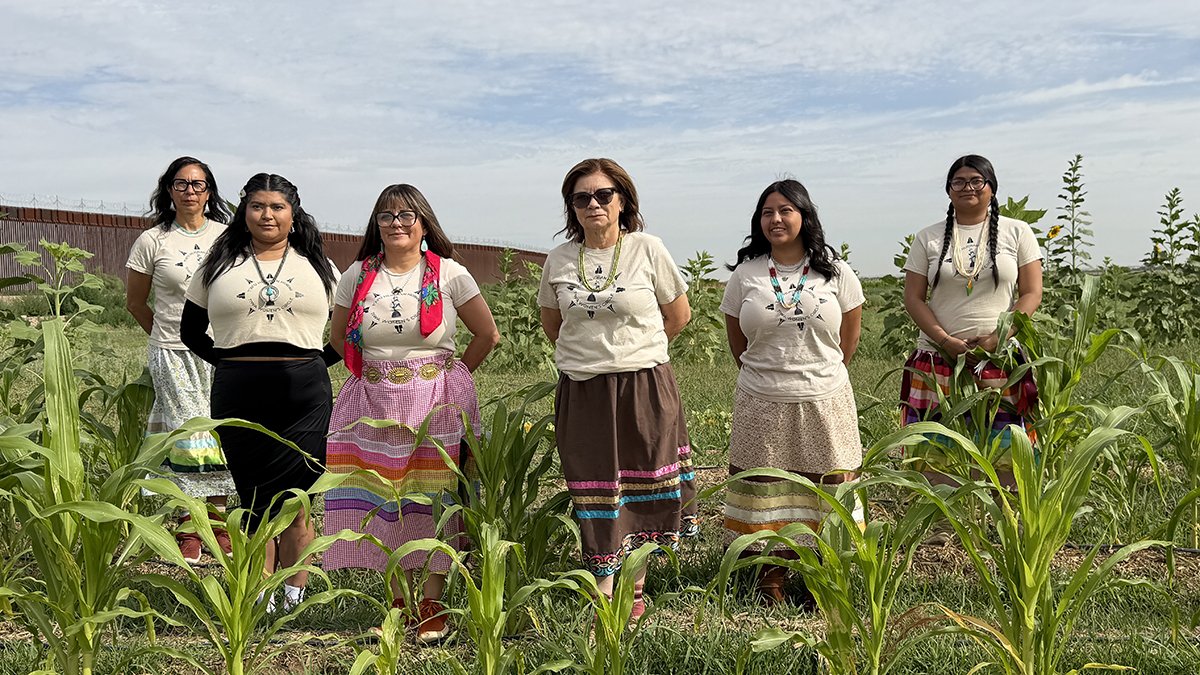
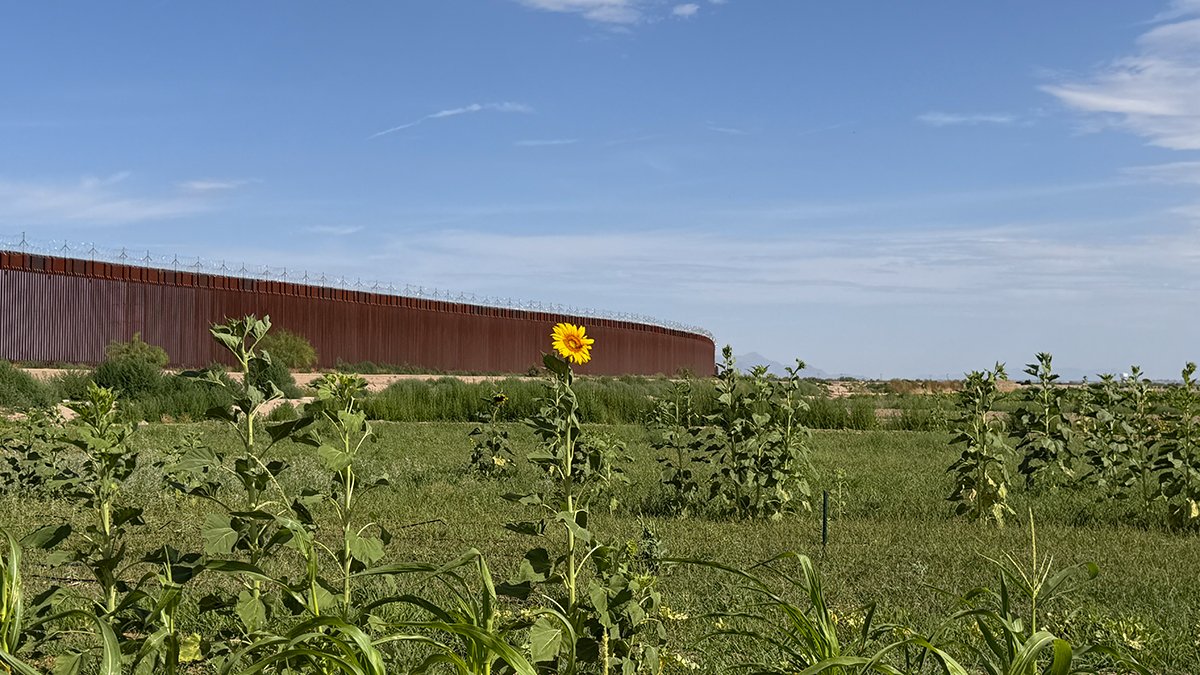
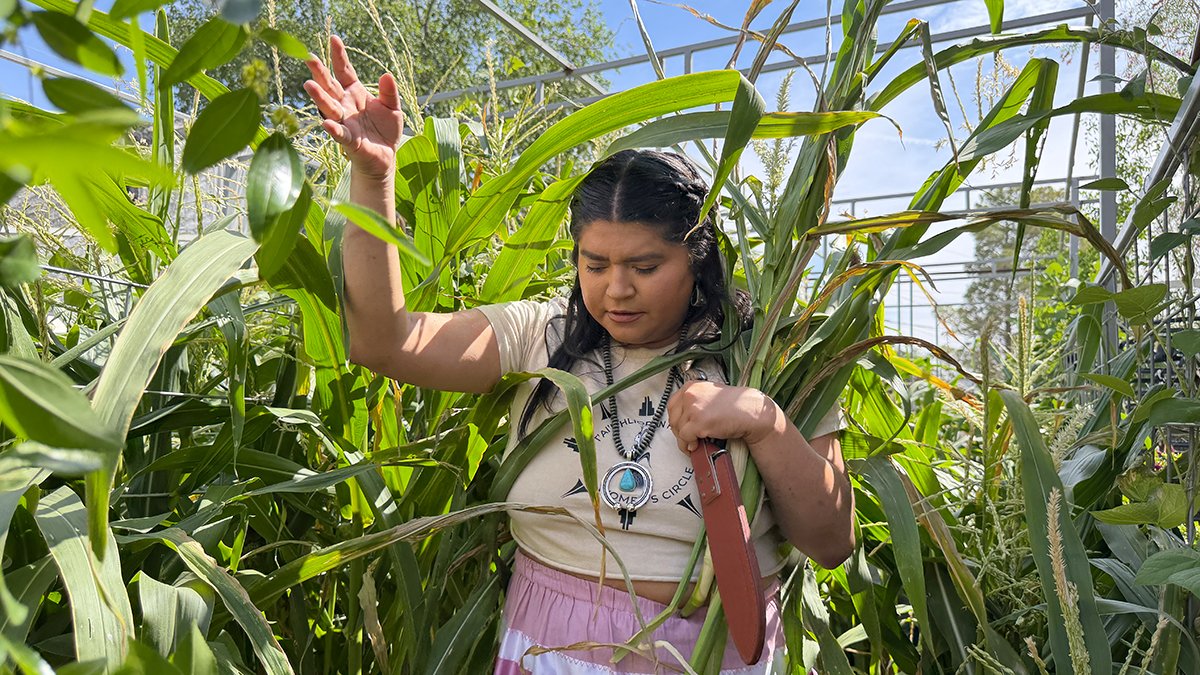
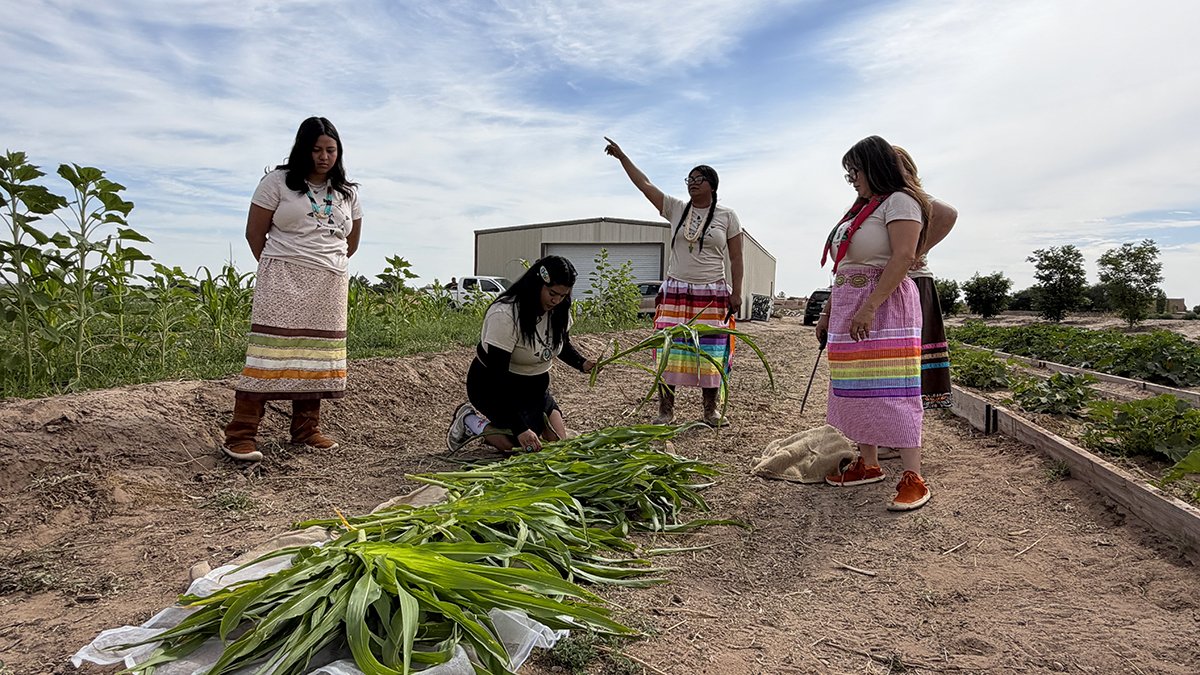
Less than one-hundred feet from the US-Mexico border wall, Jessica Macias stands in a field of waist-high corn. Her hair in two thin braids, she wears a t-shirt and skirt, a rainbow of ribbons circling its folds, and offers a prayer.
The prayer is for the land. Specifically, a one-acre plot just south of El Paso, Texas farmed by the T’ai’u Hlioran Hurini, or Tiwa Women’s Circle, a collective of women from Ysleta del Sur Pueblo, a federally recognized Indigenous tribe and sovereign nation.
The T’ai’u Hlioran Hurini farm was created from “a recognition of lateral violence that happens in our community, and wanting to bring back matrilineal roles,” says its founder, Andrea Everett.
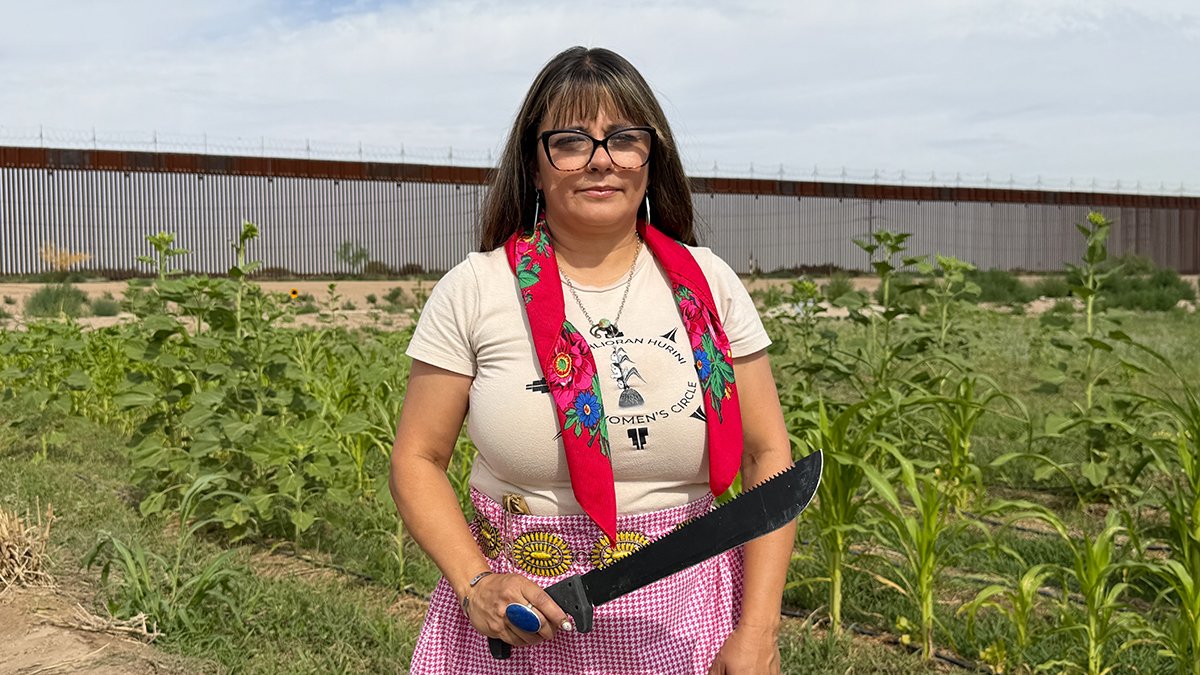
After the prayer, Everett sprinkles cornmeal from a small leather pouch onto the ground the edge of the cornfield. “Pretty much everything we do is set with intention,” she says. “We say a prayer first and make offerings and go in with a good heart and mind.”
She lays out several sheathed knives for the women to use then holds up a large, serrated machete and laughs. “Let’s do this.”
She steps into the field and explains how to assess and cut corn stalks. “We’re going to avoid anything with tassels, especially ones that already have corn growing. We’re not going to pull it; we’re going to cut it.”
On this June morning, six of the Circle’s eight members have come to gather cornstalks for the annual feast ceremony on June 13, blending the tribe’s long time Corn Dances with an homage to its patron saint, St. Anthony. For many tribal members, the feast also honors deep relationships with the natural world.
Re-matriating the land
Centuries ago, the people of Ysleta del Sur—who call themselves Tigua or Tiwa—lived in Quarai, southeast of what is now Albuquerque, New Mexico. Severe drought and Apache raids pushed them to live with their relatives in Isleta Pueblo, and in 1680, during the Pueblo Revolt, they were captured by the Spanish and forced to walk over 400 miles south. In their new (and current) home, Ysleta del Sur Pueblo, they replicated the acequias of their homelands to create a thriving agricultural community.
“Farming and being with the land is who we really are,” Everett says. “There are so many outside influences that have affected who we are as Pueblo people. Returning back to the land, doing things that our elders and relatives and ancestors did is important.”
Everett says she kept hearing the calling to bring women together to remember their kinship relationship with the land. “Not only women my own age, but also youth and even elders that weren’t able to have that in their time because that was taken from them,” she says.
Everett’s mother, Pat Gomez-Riggs, 64, is the “Nana” or grandmother of the group. For her, the T’ai’u Hlioran Hurini is about reclaiming agency as Pueblo women.
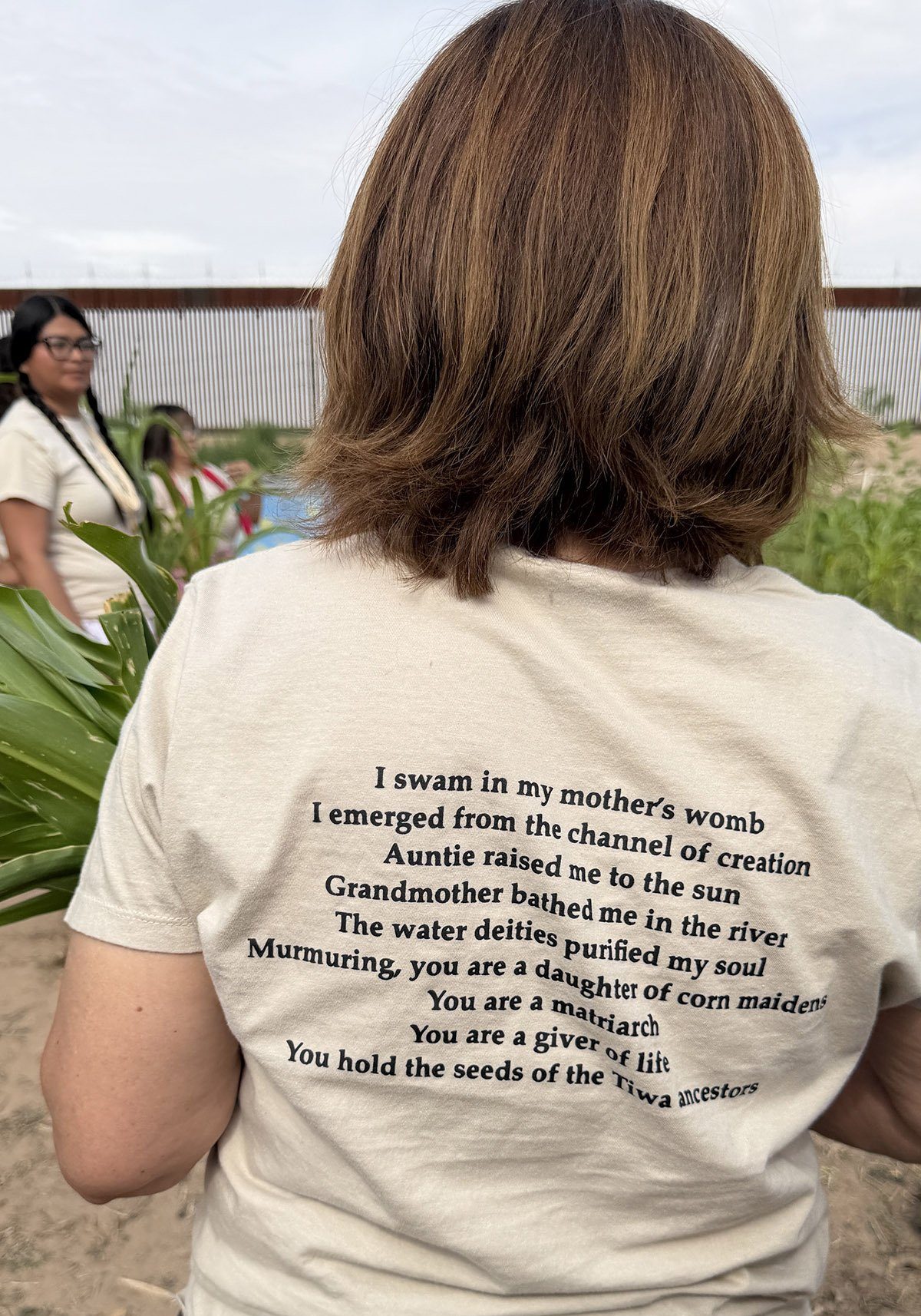
“We were matriarchs and we are still matriarchs, but there’s so much of an imbalance now. We wanted to create balance, to create a closer tie to not just the land but our ancestors and our grandmothers. We wanted to know that we have more value that has been stripped from us over the years.”
The Circle’s youngest member, Vivian Velasquez, 18, visited the farm during her spring break. “We did a lot of digging, amending the soil and doing hard work. I was like, ‘Oh, I love it here,’ so I started coming more,” she says. A month afterwards, she was invited to join the circle.
“She’s good at everything she does,” Everett says.
The Circle’s intergenerational membership reflects deep Pueblo traditions, says Cheyenne K’aive Pathu, another member. “You want the Nanas there and the Tatas there to guide you in the old ways, and you want to share that with the new and the young ones.”
For her, as a mother, being able to bring her children to the farm and involve them in Circle activities is important. “My ten-year-old has been out there pulling the hose, watering the garden, planting the seeds.”
K’aive Pathu works as a model and a chef and teaches cooking classes to help tribal members incorporate native foods back into their diet for better nutrition. “I work a lot with the three sisters—corn, squash, and beans—and also amaranth, a superfood with a lot of health benefits,” she says.
But she had never grown her own food before joining the Circle. “That’s one thing that got me really excited, having a community garden and tending to Mother Earth. It was my first experience with farming.”
Tanya Nuñez, a full-time musician based in Albuquerque, joined T’ai’u Hlioran Hurini to reconnect with her tribe, since she has no immediate family members in Ysleta. She travels south for the women’s gatherings, farmwork, and special tribal events like the feast.
“It just made sense. An opportunity to focus on re-matriation, just to build connection with my sisters and relatives and the land itself and our cultural ways,” Nuñez says.
Adapting to current conditions
Farming in arid lands brings countless challenges. A week before the feast day, an issue with the cistern pump meant the women had to water everything by hand. Another day, a breach on a neighboring farm’s canal allotment brought unexpected flooding.
Lately, when Everett arrives at the farm, two burrowing owls greet her with squawks and cries. “I don’t like them,” she says. “They’re bad luck for us.”
Most days, a white truck is parked near the border wall. “We have our own personal border patrol,” Everett says. “They are always listening.” In recent years, little to no human traffic crosses the border here, but the surveillance is steady.
“The militarization of our border is all around us. For us, this farm serves as resistance against those colonial powers and colonial ideologies,” she says.
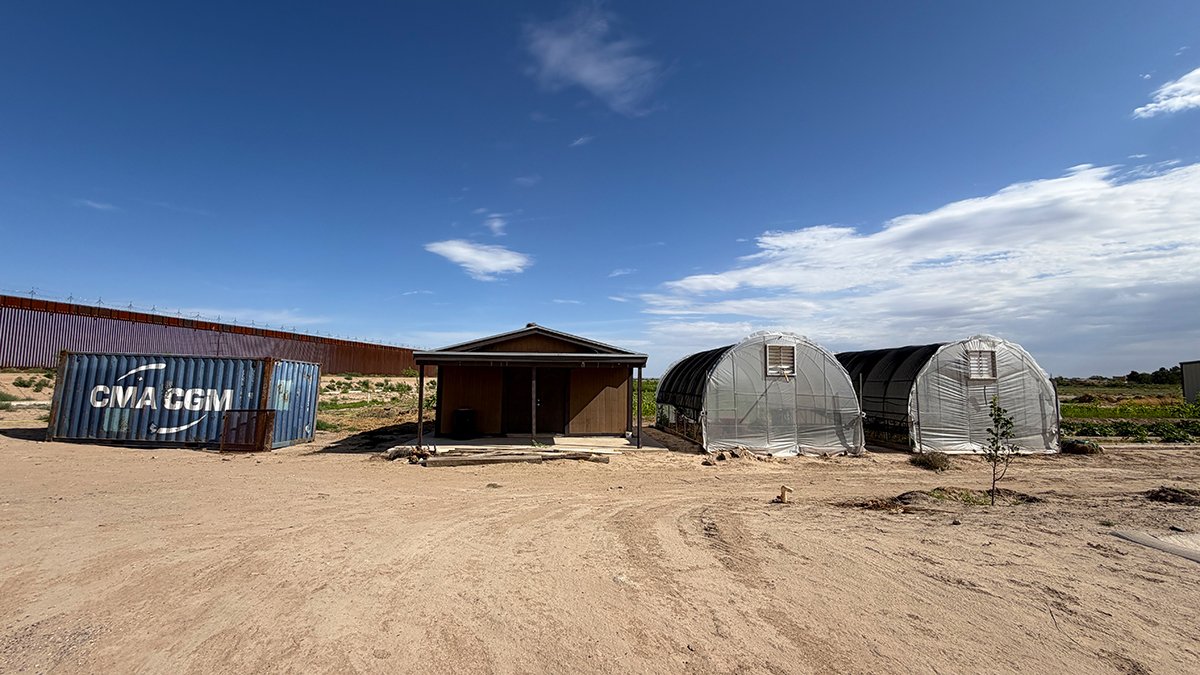
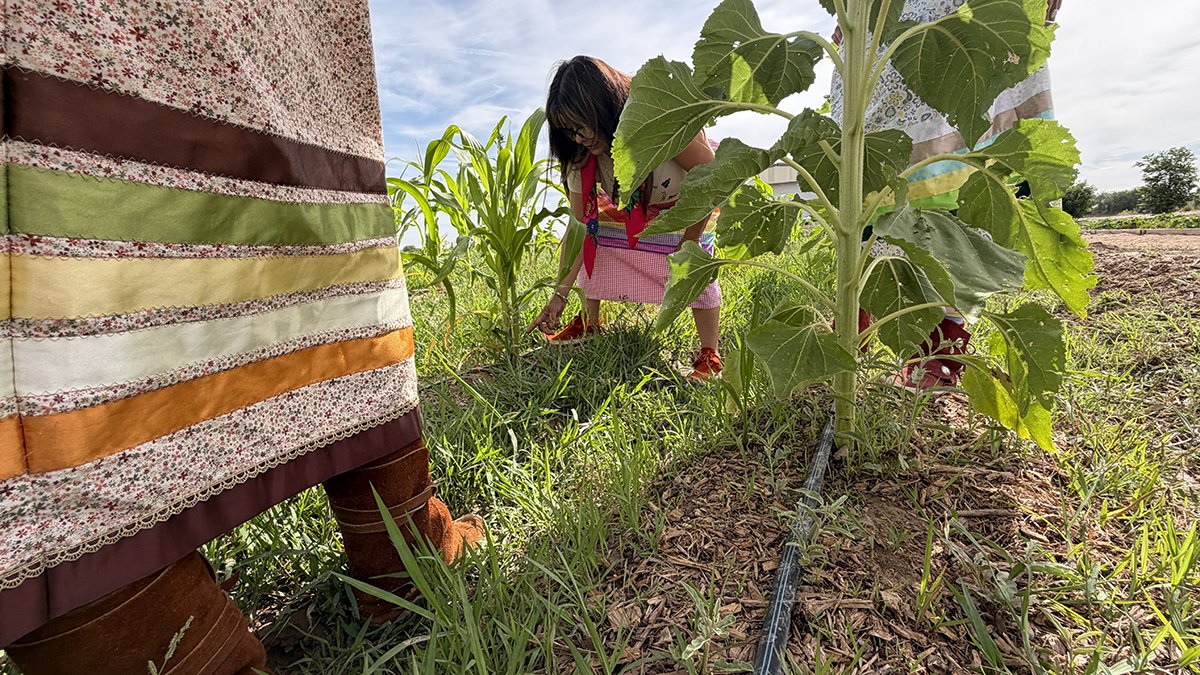
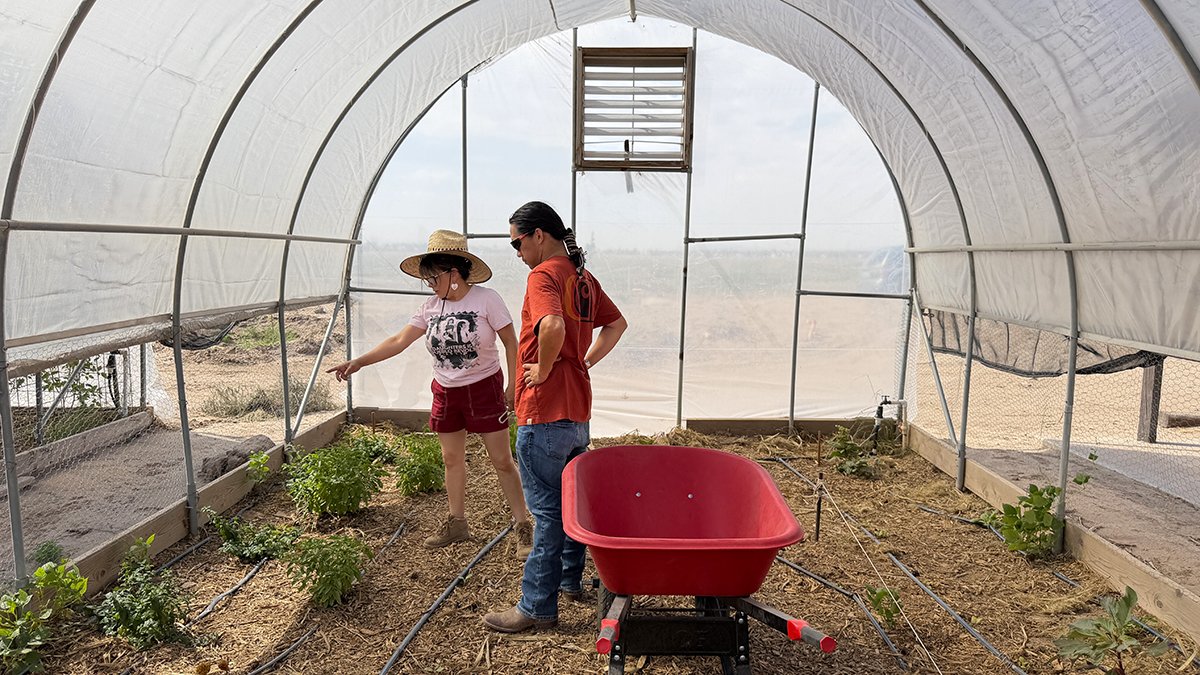
In the farm’s two hoop houses, the women have planted amaranth, Anasazi beans, Isleta tobacco, and Hopi watermelons. These seeds are planted by hand, which is how they prefer to do all farmwork.
The farm’s first hoop house, called the Corn Mother’s House, was built by hand. But the second hoop house, the Medicine House, they used machinery to help turn the soil. When it became evident that seeds planted in the first house were doing much better than those in the second, Everett says, they re-dug the soil in the Medicine House and made offerings. “We prayed and we sang Now it’s flourishing because the land needed more from us,” she says.
For Everett, healthy soils are key to the farm’s success. “We have to be able to give our plants a fighting chance to combat these heats, these dry spells, these different factors that are changing the landscape,” she says.
As climate change drives severe temperature increases, extended droughts, and altered monsoon patterns in the Chihuahuan Desert, the T’ai’u Hlioran Hurini farmers are learning about adaptation strategies.
Everett participates in a circle of leaders from communities across the United States working on the front lines of climate change. The Heritage Adapts to Climate Alliance (HACA) Community Leader Circle capitalizes on the new Global Goal on Adaptation Framework adopted by governments around the world, which acknowledges the significance of heritage sites and cultural practices in climate adaptation and international climate policy. The HACA Community Leader Circle offers funding, networking, and professional opportunities to heritage leaders in local communities.
Everett received HACA funds through a fiscal sponsor (Southwest Folklife Alliance) to support the T’ai’u Hlioran Hurini farm, to document the project, and to travel to climate policy gatherings to share her work.
Through the HACA Circle, Everett has exchanged stories and ideas with Indigenous and heritage-based community leaders, including the protectors of Hawaiian fish ponds, advocates for a Tijuana estuary, the Gullah people facing rising seas in South Carolina, and others. These exchanges have illustrated the power of ancestral ways of knowing in climate adaptation strategies.
“We don’t have to think about these global scales, right? We can think about our own spaces and communities and how to support the land. Then we can build policies to sustain the land and create ecosystems of care and reciprocity.”
Everett says the conversations illuminate what is working for each community. “A lot of it is creating a foundation.”
Returning to roots and soil and adapting to conditions is what the Pueblo people have always done. “We knew how to pivot, we knew how to adapt. If we had to abandon areas then we did, but we left markers on the land to tell us which direction the people went, what animals you could find there, where there was water and looking at it as a complete cultural landscape,” Everett says.
Networking with other Pueblo and drylands farmers has also introduced the women to effective climate adaptation strategies.
A Yaqui farmer recently advised Everett to bury seeds at least five inches in the ground to give the roots a chance against high winds in the springtime. “We’re seeing that the winds are starting earlier and they’re continuing longer. They’re bringing fungal disease.”
This means planting corn even deeper, she says. “Three inches is not enough. We have to root even deeper, dig deeper into the caliche. These layers need to be cracked open,” she said.
This is a return to an ancestral drylands farming practice, Everett says. In this way, connecting with roots happens on multiple levels.
“For us it’s about bringing back the cultural agricultural practices, whether that’s a planting stick, breathing our life force into the seeds and taking the time to do that for every seed.” because every single life and every seed we put into the soil is important and needs to be supported.
The world needs our prayers
The Corn Dances and the Feast of St. Anthony of Padua are celebrated every year in communities around the world. This patron saint of lost things, miracles, and the poor, is honored in Ysleta del Sur with a community procession, in which tribal members carry a figure of the saint through the streets to the mission, where novenas are offered. The following morning, the saint is honored with a mass and a series of dances, in which over one hundred tribal members dress in full regalia and dance under an open sky, in full June sun. [Note: no photographs of the ceremony are permitted.]
“It’s a physical form of prayer,” says Everett. “Those of us who dance, our drum beats the heartbeat of our pueblo. We are not only dancing for ourselves, for our community, for our family, but we’re dancing for the whole world.”
While several men drum, dancers form parallel lines then run, circling the space repeatedly to form a figure X, representing the four cardinal directions. Women carry arrows and men hold bows. “We dance from the time we are at the Tuh-la in our kiva from the time that the sun comes up till way past after dark. We give our all out there. It’s a sacrifice,” Everett says.
But the sacrifice is worth it. “The world needs a lot of prayers,” she says.
Feast days require weeks of planning, Everett says. Men gather cepas or mesquite wood for the adobe hornos where bread and biscochos (biscuits) are baked; others gather corn stalks to offer; others prepare the feast and dining room. The community is fed a traditional meal prepared by fellow tribal members.
“There’s a lot of logistics, planning and getting everybody together. But no matter what is going on with each other personally, we set those things aside so that the greater good of what we are trying to do is done,” Everett says.
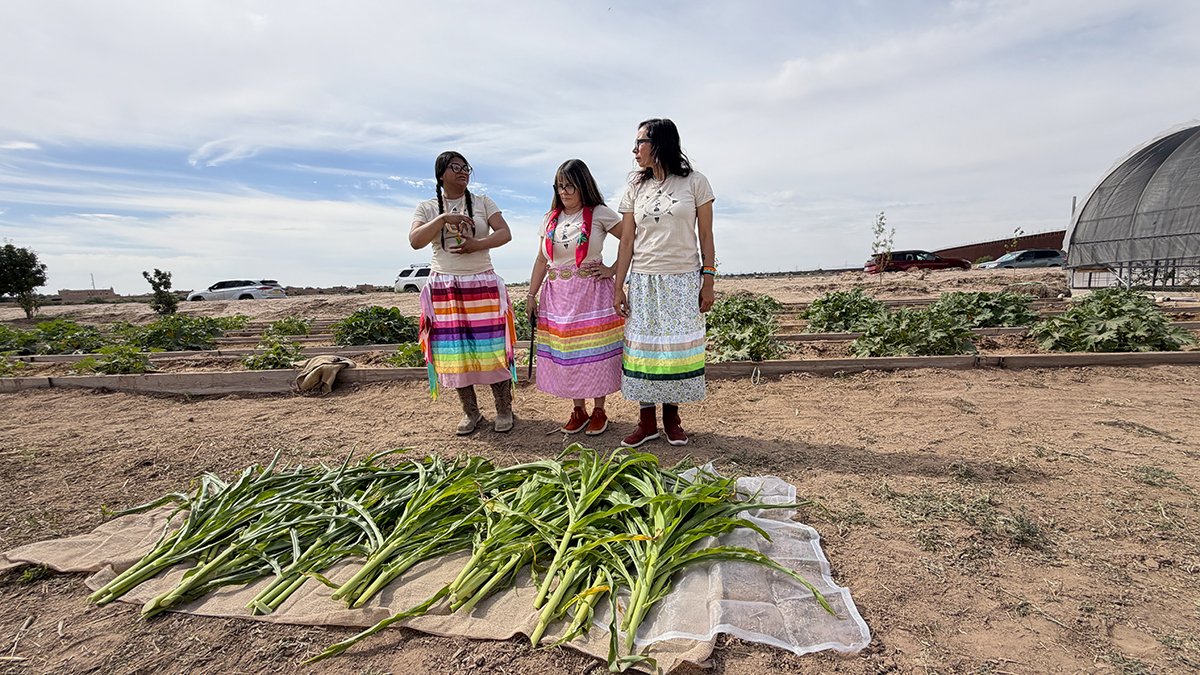
The same could be said of the T’ai’u Hlioran Hurini farm, where the farmers work to practice healthy kinship with one another and with the land itself.
“[Everett] planted that seed and slowly it’s been watered,” K’aive Pathu says. “We are connecting to that matriarchal society that is within the Pueblo realm and culture.”
Everett says that even the challenges have kept her going toward that goal. And all the while, she’s felt “cradled” by the land, she says.
“It’s been so healing for us,” Everett said. “Especially for me. Sitting out here on the farm, a lot of times you hear the wind, you hear voices, and you understand.”
I love this. Blessings for the women and their plants. This is where it all begins.